
Ceramic Pump vs Polyurethane Pump: Wear Life & Cost Performance Analysis
Mineral processing plants face continuous wear challenges from fine abrasive slurry. Polyurethane (PU) and SiC ceramic are two popular non‑metallic wet‑end material options beyond high‑chrome alloy and natural rubber. Many site engineers struggle to choose between ceramic pump and polyurethane pump, confused by initial purchase price, actual wear‑life, chemical compatibility and real‑world cost‑performance. Wrong material selection brings frequent spare‑parts replacement, unplanned downtime and hidden production losses. As a professional slurry pump manufacturer, XO Slurry Pump (www.xoslurrypump.com) provides both SiC ceramic and polyurethane wet‑end components for global mineral‑processing clients.Polyurethane elastomer features excellent tear‑resistance and impact buffering capability, widely applied in fine‑medium particle slurry conditions. SiC ceramic reaches Mohs 9.2 hardness, delivering outstanding anti‑cutting abrasion and chemical inertness, yet limited by brittleness under heavy particle impact. Neither material fits all mining scenarios. Operators need to evaluate particle property, slurry chemistry, temperature and total‑cost‑of‑ownership instead of only comparing component unit price.
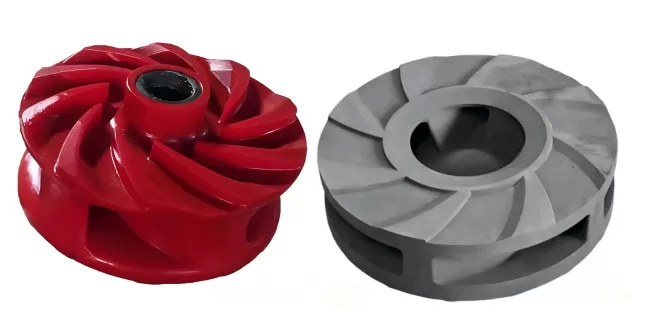
Alt text:SiC ceramic and polyurethane wet‑end components side‑by‑side for mining slurry pump material comparison
Core Performance Comparison: Ceramic Pump VS Polyurethane Pump
The differences focus on wear mechanism, impact tolerance, chemical stability, temperature adaptability and comprehensive cost‑performance.
Table 1 — Performance comparison: SiC Ceramic Pump vs Polyurethane Pump
| Evaluation Item | SiC Ceramic Pump | Polyurethane (PU) Pump |
|---|---|---|
| Core material | Reaction‑sintered silicon carbide | Mining‑grade cast polyurethane elastomer |
| Main wear mechanism | Resist cutting abrasion from sharp fine particles | Absorb impact, resist tear and sliding friction |
| Impact tolerance | Poor, vulnerable to tramp‑particle impact crack | Good, absorbs particle impact without brittle fracture |
| Chemical resistance | Excellent for most acid‑alkali slurry | Limited under strong acid / alkali, easy hydrolysis at high temperature |
| Allowable slurry temperature | Wide temperature range | Generally ≤70℃‑80℃ for mining‑grade PU |
| Typical service life (fine sharp‑particle slurry) | 8‑18 months | 3‑8 months |
| Initial component cost | Higher unit price | Lower initial purchase cost |
| Suitable working conditions | Fine sharp abrasive, corrosive slurry, no large tramp particles | Medium‑fine particles with occasional tramp impurity, neutral‑weak corrosive slurry |
1. Wear‑Life Difference Under Abrasive Slurry
For fine sharp‑edged quartz‑rich slurry, SiC ceramic slurry pump shows prominent advantages against cutting‑type abrasion. Hard ceramic surface is hardly scratched by sharp mineral particles, so wet‑end keeps stable geometry for long running hours.Polyurethane slurry pump performs well for sliding‑abrasion scenarios. However, under continuous scouring of sharp angular particles, PU material will gradually produce cutting damage and tear failure. Its service life is obviously shorter than SiC ceramic under high‑sharp‑particle‑abrasion conditions. But PU will not crack when small tramp particles accidentally enter pump cavity, which is a key advantage over ceramic solutions.
2. Chemical & Temperature Adaptability
SiC ceramic is chemically inert, stable under most acidic‑alkaline mineral slurry and high‑temperature tailings, no swelling or hydrolysis failure occurs.Polyurethane elastomer faces obvious constraints: strong acid, strong alkali or slurry temperature exceeding 70‑80℃ will cause PU hydrolysis, softening and accelerated aging, sharply shortening component service life. For hydrometallurgy corrosive working‑conditions, ceramic becomes a more reliable choice.
3. Real‑World Cost‑Performance & TCO Analysis
Many mines only focus on spare‑parts unit price. Although PU slurry pump wet‑end has lower upfront cost, frequent replacement brings cumulative parts expense plus downtime production loss.Even though ceramic wet‑end has higher initial investment, its longer service life reduces shutdown frequency, labor‑cost for maintenance and production interruption loss. For continuous‑running concentrator with fine sharp‑particle corrosive slurry, ceramic pump brings better long‑term cost‑performance. For working‑conditions with unavoidable tramp‑particle impurity and medium‑abrasion neutral slurry, polyurethane remains a cost‑effective option.
Practical Selection Principles for Mining Sites
Choose ceramic pump: Fine sharp abrasive particles, corrosive slurry, stable feeding without large tramp‑metal / oversize particles.
Choose polyurethane pump: Medium‑fine particles, occasional tramp impurity, neutral‑weak‑corrosive slurry, slurry temperature below 70℃.
Strictly avoid ceramic pump for working‑conditions with frequent large‑size hard‑particle impact.
Avoid polyurethane pump under hot strong‑acid or strong‑alkali slurry environment.
Common Selection Mistakes
Only compare spare‑parts unit price while ignoring downtime loss caused by frequent component replacement.
Apply polyurethane under high‑temperature strong‑corrosion slurry, leading to rapid hydrolysis and early failure.
Adopt ceramic wet‑end without effective pre‑screening, tramp‑particle impact causes ceramic cracking damage.
Conclusion
Both ceramic pump and polyurethane pump have their own applicable boundaries. Polyurethane pump features good impact resistance and low initial cost, suitable for medium‑abrasion neutral slurry with occasional tramp particles. SiC ceramic pump delivers superior cutting‑abrasion resistance and chemical stability, ideal for fine sharp‑particle corrosive mineral slurry. Mining operators should comprehensively evaluate particle characteristic, slurry chemistry, temperature and total‑cost‑of‑ownership rather than simply pursuing low‑price components.XO Slurry Pump supplies interchangeable SiC ceramic and polyurethane wet‑end spare‑parts. Visit www.xoslurrypump.com for professional working‑condition evaluation and material‑selection consultation.