
Low‑Maintenance SiC Pump Reduce Mine Unplanned Downtime
Unplanned downtime caused by rapid wear of slurry pump wet‑end parts creates heavy economic losses for mineral‑processing plants. In high‑abrasion circuits such as cyclone feed, tailings transport and flotation, traditional high‑chrome alloy components require frequent shutdown for inspection and replacement. The low‑maintenance SiC slurry pump equipped with silicon‑carbide wet‑end parts offers an effective solution to lower mine unplanned downtime, extending maintenance cycles and stabilizing continuous mining production. This article analyzes its working advantages, applicable scenarios and practical limitations for mine operators.
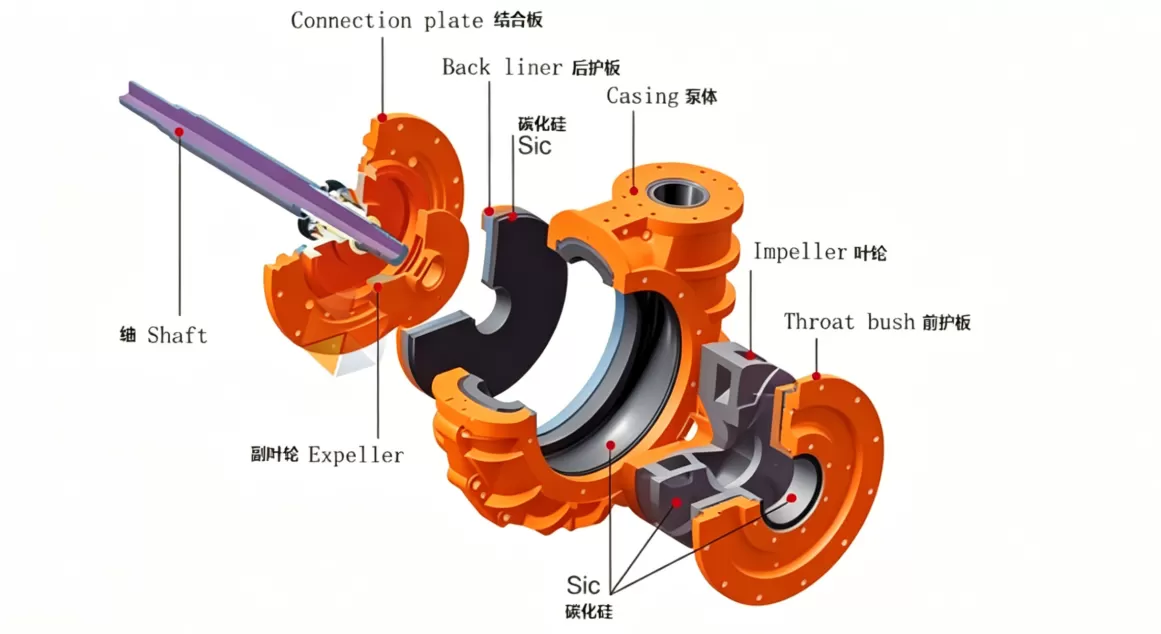
Schematic diagram:SiC slurry pump wet‑end assembly
Silicon carbide (SiC) ceramic features extremely high hardness and excellent chemical inertness, far exceeding high‑chrome alloy in anti‑abrasion and anti‑corrosion performance. In real mine cases, SiC wet‑end components can reach 3‑8 times longer service life than traditional metal counterparts under equivalent abrasive‑slurry conditions. The SiC impeller and SiC liner resist particle cutting and slurry erosion; their surface wears slowly and uniformly. Unlike alloy parts, which suffer sharp efficiency drop after partial abrasion, SiC components keep relatively stable hydraulic performance throughout the whole service cycle.
Reduced wear rate directly brings two core benefits for mine sites. First, maintenance frequency decreases greatly. Maintenance crews spend less labor on frequent disassembly, inspection and spare‑part replacement. Second, predictable wear progress helps shift from emergency breakdown repair to planned preventive maintenance. Mine engineers can arrange component replacement during regular plant shutdown windows, avoiding sudden production halt triggered by unexpected pump failure. Nevertheless, SiC ceramic has inherent brittleness. It is not suitable for working conditions with excessive large‑size ore particle impact; violent mechanical shock may cause cracking of ceramic wet‑end parts.
Material matching is critical when selecting a ceramic slurry pump. SiC excels for fine‑to‑medium hard‑particle slurry, corrosive acidic‑alkaline slurry and continuous‑running high‑abrasion circuits. For sites with massive coarse ore impact, hybrid solutions can be adopted: keep high‑chrome alloy for impact‑vulnerable positions while using SiC for other wet‑end components, balancing impact resistance and wear‑resistant performance.
【Table Place 1:Performance comparison: SiC wet‑end parts vs high‑chrome alloy wet‑end parts】
| Comparison Item | SiC Wet‑end Parts | High‑Chrome Alloy Wet‑end Parts |
|---|---|---|
| Abrasion Resistance | Excellent, 3‑8 times longer service life | Good, regular periodic replacement required |
| Corrosion Resistance | Strong, adapt to wide pH range | Limited under strong corrosive slurry |
| Anti‑impact Performance | Poor, avoid heavy large‑particle shock | Good, withstand coarse ore impact |
| Maintenance Frequency | Low, long planned maintenance cycle | High, frequent inspection & replacement |
| Risk of Unplanned Downtime | Greatly reduced | High risk after rapid local wear |
Table 1: Performance comparison between SiC and high‑chrome alloy slurry pump wet‑end components
Practical Guidelines for Deploying SiC Slurry Pumps in Mines
Screen suitable working conditions first. Prioritize SiC slurry pump for tailings pipelines, cyclone‑feed circuits and corrosive mineral slurry with fine‑medium particle size. Avoid applying pure SiC components for circuits with frequent oversized‑particle impact.
Evaluate total cost of ownership rather than initial purchase price. Although SiC wet‑end parts carry higher upfront cost, savings from reduced labor expense and avoided mine unplanned downtime usually offset extra investment within short operation periods.
Optimize system operating parameters. Strictly prevent dry‑running and violent water‑hammer phenomena, which may crack SiC ceramic components. Keep slurry particle size within material allowable range.
Keep proper spare‑parts inventory. Even low‑maintenance SiC pumps need standby silicon carbide slurry pump parts for occasional replacement, to guarantee rapid response during planned overhaul.
Common Misunderstandings
Some plant managers regard SiC slurry pump as universal upgrade solution for all mining‑pump circuits. In fact, its brittleness decides it cannot fully replace high‑chrome alloy pumps for heavy‑impact coarse‑ore duties. Another misunderstanding assumes SiC parts require zero maintenance. Operators still need regular visual inspection and monitoring of pump vibration and noise, to detect hidden ceramic micro‑cracks at early stage.
When retrofitting existing mining slurry pump with SiC wet‑end components, confirm dimensional interchangeability with original pump frame. Not all pump models support direct ceramic‑part retrofit, and technical verification from pump manufacturer is necessary.
If you want to explore low‑maintenance SiC slurry pump and silicon‑carbide wet‑end‑part solutions for your mineral‑processing circuits, our engineering team provides working‑condition assessment and component matching service. Visit https://www.xoslurrypump.com to check our ceramic‑series pump and spare‑part catalog.
Conclusion
Low‑maintenance SiC slurry pump delivers obvious value to mitigate mine unplanned downtime. The SiC impeller, SiC liner and other wet‑end parts greatly extend service cycle and cut maintenance workload for high‑abrasion slurry circuits. Mine operators should match SiC ceramic components to suitable slurry conditions while being aware of material brittleness limits. Proper application of silicon‑carbide slurry pump parts helps mineral‑processing plants achieve more stable continuous production and optimize overall lifecycle operating cost.