
Metal-Ceramic Composite Structure: Solve Ceramic Pump Brittle Problem
Silicon carbide ceramic slurry pump delivers excellent abrasion resistance for fine abrasive slurry, but inherent brittleness limits its promotion in mining sites. Shock load, large particle impact and thermal shock often lead to chipping or cracking of pure ceramic wet end parts. The metal-ceramic composite structure is developed to solve ceramic pump brittleness, combining the wear resistance of SiC ceramic and the toughness of metal substrate. This article explains the design logic, performance advantages and application guidance, brought to you by our slurry pump engineering team at www.xoslurrypump.com.
Why Pure SiC Ceramic Slurry Pumps Crack Easily
Pure SiC ceramic is hard and anti-abrasive, yet it is a typical brittle material. It has high compressive strength but very low fracture toughness. In mineral processing circuits, sudden impact from coarse particles, water hammer, uneven thermal change or installation stress will create tiny cracks on ceramic impellers and liners. These cracks expand rapidly under continuous slurry scouring, eventually causing component failure. For this reason, traditional ceramic slurry pump is only recommended for fine, low-impact slurry. It cannot replace high-chrome alloy pumps under medium or heavy impact conditions, which greatly restricts the value of ceramic wet end in mining projects.
Working Principle of Metal-Ceramic Composite Structure
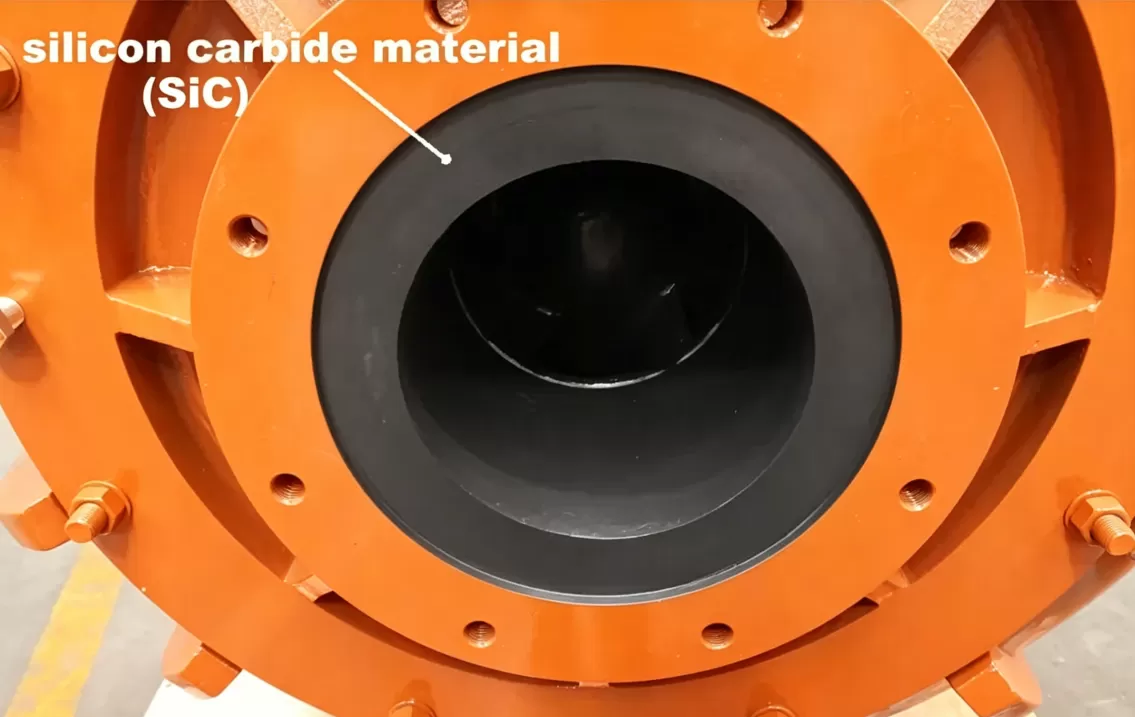
The metal-ceramic composite pump adopts a dual-layer integrated structure. The inner layer in direct contact with slurry is dense SiC ceramic, responsible for resisting particle erosion and chemical corrosion. The outer supporting substrate is ductile alloy metal, such as cast steel or high-strength chrome alloy. Through special bonding and thermal matching process, ceramic and metal are tightly combined without gap. The metal substrate absorbs impact energy and disperses stress, preventing crack expansion. Even if micro-cracks appear on the ceramic surface, the tough metal support stops cracks from spreading and avoids sudden fracture. This is the core solution to ceramic pump brittleness.
Cross-section schematic of metal-ceramic composite slurry pump impeller and liner
Comparison Table: Pure Ceramic vs Metal-Ceramic Composite Wet End
| Performance Item | Pure SiC Ceramic Wet End | Metal-Ceramic Composite Wet End |
|---|---|---|
| Abrasion resistance | Excellent | Excellent |
| Impact resistance | Poor, easy to crack | Good, metal absorbs shock |
| Thermal shock tolerance | Low | Improved greatly |
| Risk of brittle fracture | High under particle impact | Low |
| Medium adaptation | Fine slurry only | Fine slurry + occasional coarse particles |
| Repair & replacement cost | High | Moderate, longer service cycle |
Key Advantages of Metal-Ceramic Composite Slurry Pump
First, it retains the core strength of ceramic material. The SiC inner layer has far better anti-abrasion performance than high chrome alloy, especially for fine silica, tailings and lithium ore slurry. It can greatly extend the service life of the wear parts. Second, the composite structure overcomes ceramic pump brittleness. The metal support improves toughness and impact resistance, so the pump can handle occasional coarse particle impact and unstable flow conditions that pure ceramic pumps cannot survive. Third, it reduces the sensitivity to installation error and thermal fluctuation. The metal substrate matches the pump’s metal shaft and casing better, lowering residual stress during assembly. For many mineral plants, this composite wet end becomes a cost-effective upgrade option between alloy pumps and pure ceramic pumps.
Suitable Working Conditions & Operation Notes
Metal-ceramic composite slurry pump is ideal for high-abrasion fine slurry scenarios: lithium leaching slurry, flotation tailings, sand washing slurry and chemical mineral slurry with mild corrosion. It still is not designed for continuous large lump heavy impact. Operators should avoid direct feeding of oversized rocks. Maintain stable feed flow to reduce water hammer shock. During installation, avoid hammering directly on the ceramic surface. Regular inspection of the ceramic surface for tiny pits is recommended.
Conclusion: Composite Design Expands Ceramic Pump Application Boundary
The biggest bottleneck of ceramic slurry pump has always been brittleness. The metal-ceramic composite structure perfectly combines ceramic wear resistance and metal toughness. It solves the cracking problem while keeping outstanding anti-abrasion performance. For mining and mineral processing customers chasing long wear life without high brittle failure risk, composite wet end is a reliable technical choice. If you want to learn more about metal-ceramic composite anti-abrasion pump solutions, reach out to our technical team at www.xoslurrypump.com.