
Retrofit Old FGD with SiC Ceramic Slurry Pump
Wet flue gas desulfurization remains the dominant emission control route for coal‑fired power plants, steel mills and waste incineration facilities worldwide. At the heart of every scrubber loop sits the FGD circulation pump, continuously pumping limestone‑gypsum slurry loaded with fine abrasive solids, chloride ions and acidic by‑products. After years of service, most original alloy or rubber‑lined FGD pumps suffer accelerated erosion, pitting corrosion, flow drop and frequent seal leakage, forcing repeated shutdowns and high spare‑part expenditure. Instead of purchasing a complete new pump unit, many plant operators choose to retrofit their old FGD with SiC ceramic desulfurization pump wet parts, balancing capital budget and long‑term reliability.
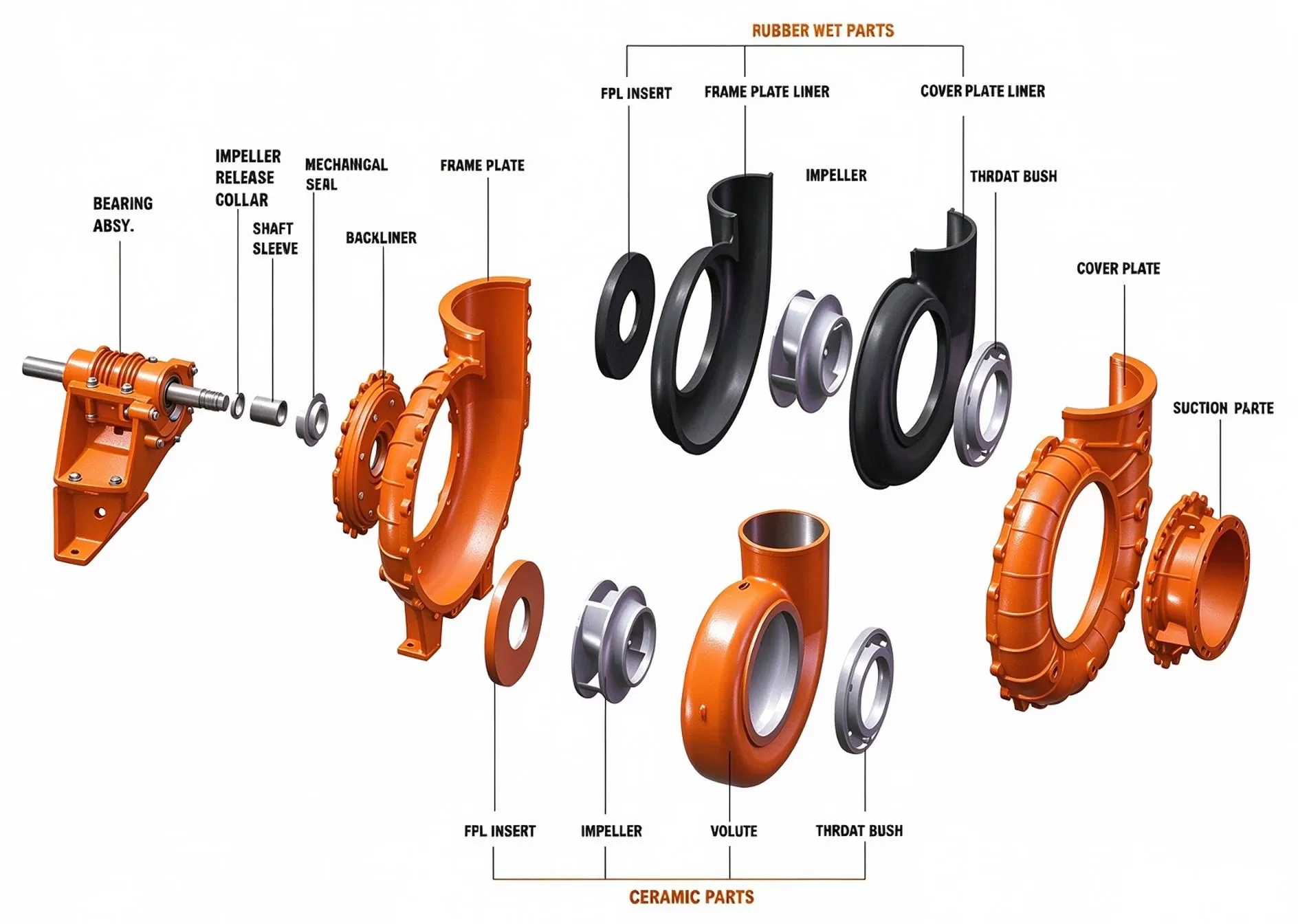
Alt text: Schematic showing retrofitted FGD circulation pump with silicon carbide impeller, liner and throat bush
Traditional high‑chrome alloy and natural rubber liners are widely used in standard FGD circulation pumps, yet they have clear limits under harsh slurry conditions. Gypsum and fly ash particles steadily abrade flow surfaces; high chloride concentration triggers crevice corrosion on alloy surfaces. Once the impeller and liner wear down, internal clearance increases, pump hydraulic efficiency declines, power consumption rises and desulfurization stability cannot be guaranteed. In many retrofit cases, the pump bracket, shaft, bearing assembly and piping interface are still structurally sound, which means only the wetted components need replacement. This is where SiC wet parts deliver the strongest commercial value.
Pressureless sintered silicon carbide is chemically inert to most acidic FGD slurries and resistant to chloride‑induced corrosion. With high Mohs hardness and dense, low‑porosity microstructure, SiC ceramic wet parts withstand continuous particle erosion far better than high‑chromium iron. When retrofitted into an existing FGD circulation pump, the SiC impeller, volute liner and throat bush preserve smooth hydraulic profiles over a much longer runtime. Unlike rubber linings that swell, peel or suffer thermal aging, silicon carbide maintains stable geometry and surface finish, helping the pump retain rated flow and head for years.
【Table 1: Performance comparison — Original alloy FGD pump vs SiC retrofit】
| Item | Original high‑chrome alloy FGD pump | Retrofit with SiC ceramic wet parts |
|---|---|---|
| Main failure mode | Abrasion, chloride pitting | Slow uniform erosion |
| Typical service life | 8,000–18,000 hours | 35,000–60,000 hours |
| Efficiency retention | Drops quickly after wear | Hydraulic profile stays stable |
| Suitable slurry | Low chloride, low solid loading | High chloride, gypsum‑rich slurry |
| Retrofit requirement | Full pump replacement often needed | Keep original pump bracket & shaft |
Before starting an FGD pump retrofit project, dimensional verification and condition assessment are mandatory. Engineers must record key mounting dimensions: impeller outer diameter, vane height, liner sealing surface, throat bush size and bolt pattern. If the pump casing structural strength and shaft runout meet specification, standardized or custom SiC ceramic wet parts can be machined for direct swap. If the casing is heavily corroded or deformed, partial casing repair or a hybrid upgrade plan will be recommended. Our team supplies interchangeable silicon carbide wet parts compatible with mainstream FGD circulation pump models, helping plants avoid custom casting delays and overbudget replacement.
Operators also need to match the retrofit solution to actual slurry parameters. Key factors include slurry solid concentration, chloride content, operating temperature, pH value and particle size distribution. For low‑chloride, moderate‑abrasion FGD loops, alloy may remain economical; for ultra‑low emission scrubbers with high recirculation rates and elevated chloride levels, retrofitting to SiC ceramic desulfurization pump components usually delivers the fastest payback. Stable pump performance also helps the whole scrubber maintain consistent liquid‑gas contact, supporting steady SO₂ removal and helping facilities stay within emission compliance limits.
Many plant managers worry about ceramic brittleness during installation and commissioning. Modern sintered SiC composite wet parts adopt metal skeleton composite structure, which improves impact resistance while keeping the ceramic layer in direct contact with slurry. Strict installation procedures, correct axial clearance adjustment and soft start protection reduce the risk of chipping. Once properly fitted, the retrofitted pump runs with less vibration, fewer seal failures and longer maintenance intervals.
Retrofitting an old FGD pump with SiC wet parts is not a universal fix, but it has become one of the most practical upgrade paths for aging desulfurization systems. It avoids the large capital cost of full pump replacement, extends the usable life of existing pump assemblies and reduces the frequency of emergency maintenance. For power and industrial plants facing tightening emission rules and rising operation costs, upgrading worn FGD circulation pumps with silicon carbide components is a proven way to stabilize scrubber performance and lower the total cost of ownership.
If you are evaluating FGD pump upgrade options for your scrubber circuit, contact us at www.sicceramicpump.com to get dimensional check guidance and quotation for interchangeable SiC wet parts for your existing desulfurization pump.