
Higher Hydraulic Efficiency: How Ceramic Pump Cuts Power Consumption
Mining, mineral processing and tailings transport sites constantly face a hidden cost drain: falling slurry pump hydraulic efficiency caused by wear. For metal wet end pumps, erosion and pitting roughen flow passages shortly after commissioning. Even if the pump still runs, extra friction loss pushes up power consumption month by month. A SiC ceramic slurry pump solves this problem by locking in a stable hydraulic profile, preserving high hydraulic efficiency and cutting power consumption over its full service life.
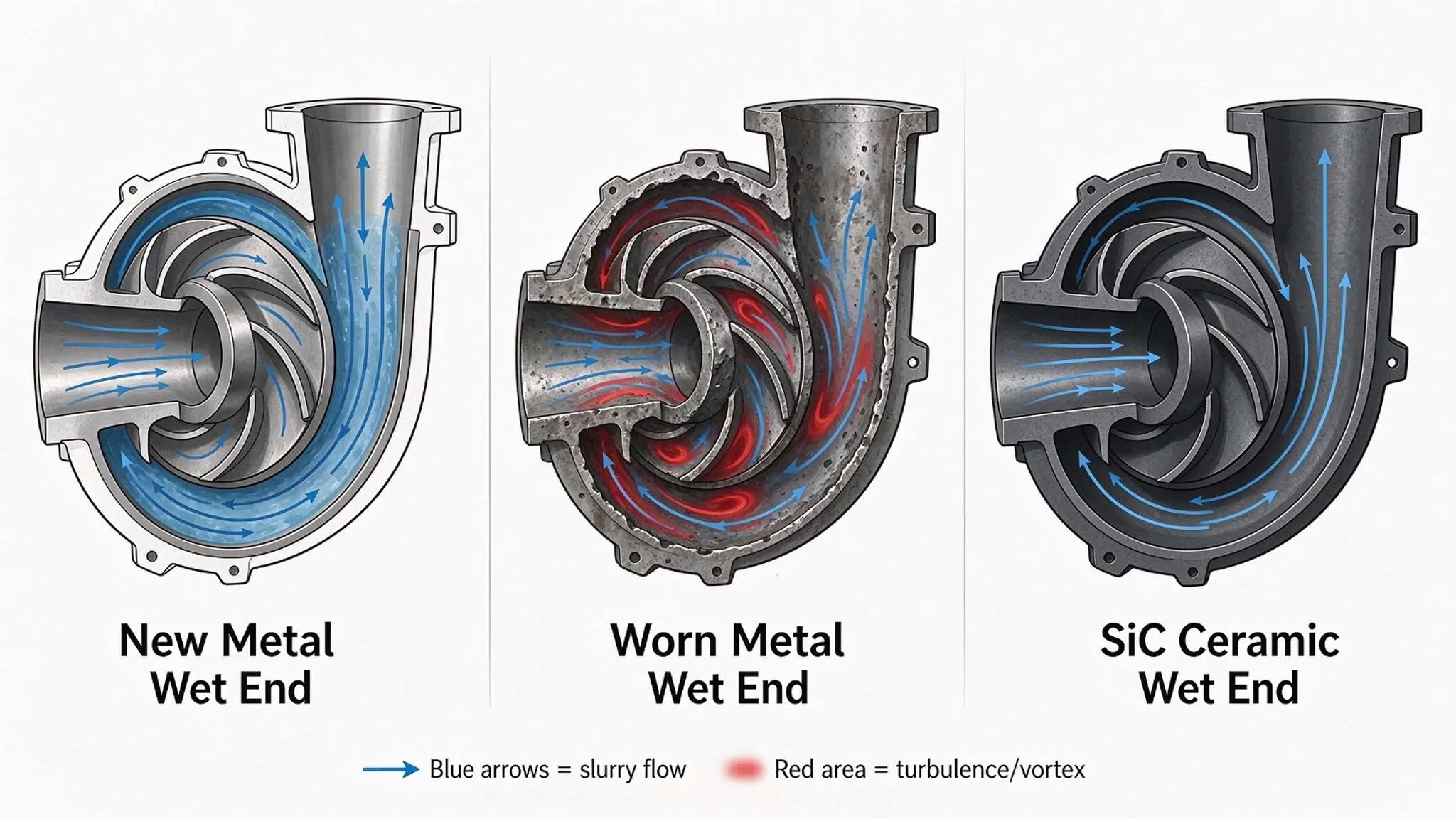
Alt text: Flow streamline comparison of new metal slurry pump, eroded metal pump and SiC ceramic pump showing flow turbulence difference
Hydraulic efficiency of a slurry pump depends heavily on surface finish and geometric consistency inside the volute, liner and impeller. Standard high-chrome iron wet parts start with a relatively smooth casting surface. But when pumping sharp, abrasive solids such as ore sand, tailings or lithium slurry, particle impact and sliding wear quickly create pits, ripples and uneven contours. These irregular surfaces trigger chaotic flow separation, vortex formation and turbulence. More turbulence means more hydraulic loss. The pump must draw more motor power to maintain the same flow rate and head. Operators often overlook this gradual efficiency drop until monthly electricity bills rise significantly.
SiC ceramic wet parts change this equation. Sintered silicon carbide delivers an extremely dense, low-roughness surface that resists both corrosion and abrasive erosion. Unlike metallic liners and impellers that deform in profile as they wear, ceramic components wear slowly and uniformly. The flow channel geometry stays nearly unchanged for thousands of operating hours. With fewer surface defects to disturb the slurry flow, turbulence losses stay low. This stable hydraulic performance is the core reason an abrasive slurry pump fitted with ceramic wet ends maintains high efficiency long-term.
【Table Place 1: Performance comparison — Metal wet end vs SiC ceramic wet end】
| Parameter | High-chrome metal wet end | SiC ceramic wet end |
|---|---|---|
| Initial hydraulic efficiency | 80–84% | 82–86% |
| Efficiency after 2000h operation | 70–76% | 80–84% |
| Typical power increase over time | +8~15% | +1~3% |
| Surface roughness evolution | Rapid roughening | Slow, uniform wear |
| Best fit | Low-abrasion slurry | High-abrasion fine/coarse mineral slurry |
Many site engineers mistakenly believe energy efficient slurry pump selection only focuses on motor rating or VFD tuning. Variable frequency drives help match output to demand, yet they cannot fix losses created inside a degraded wet end. If the impeller and liner are heavily eroded, even a well-tuned VFD will waste energy. Ceramic upgrades work at the root of the problem: preserving the original hydraulic design. For retrofit projects, swapping wet ends to SiC is often simpler and more cost-effective than replacing the whole pump unit. The pump casing, shaft and base can remain in service, while the hydraulic core regains its designed efficiency.
Not every slurry application benefits equally from ceramic pumps. Ceramic wet ends are ideal for continuous heavy-duty circuits: ball mill discharge, flotation tailings, sand washing, and fine abrasive mineral transport. They are less suitable for extreme thermal shock or large, sharp blocky rock that creates concentrated impact cracking. Before upgrading, teams should confirm slurry particle size, solid concentration, pH and peak temperature. When the operating conditions fall within the material window, the reduction in power consumption becomes measurable on site power loggers.
The financial impact accumulates steadily. Mining and processing plants run pumps 24/7. A 5% sustained reduction in absorbed power on a large slurry pump translates into substantial annual electricity savings. Combined with longer service intervals and fewer shutdowns for wet part replacement, the total cost of ownership drops sharply. Many operators report that the premium for SiC wet parts pays back within 6 to 18 months through saved power and reduced maintenance downtime.
In conclusion, high hydraulic efficiency is not only a factory datasheet number. For field operations, it is a dynamic property that decays with wear. A ceramic slurry pump keeps flow passages smooth and geometry stable, minimizing turbulence and cutting power consumption for abrasive slurry transport. When evaluating ways to lower site energy expenditure, upgrading wet ends to sintered SiC deserves consideration alongside motor and drive optimisation. For mines and mineral processors running continuous abrasive circuits, this material upgrade delivers both reliable wear resistance and lasting energy savings.